
The order and invoice describe intent. They do not independently establish the finished state.
ReadyCar Autonomous Service Verification / Patent-pending
A service order says what should happen.ASV helps prove what did.
When no driver or fleet employee is present, completion cannot depend on a glance, a paper receipt, or an unconnected photo. ASV links the vehicle, requested work, guided evidence, review result, exceptions, and release decision in one service-event record.
Shown here as an illustrative four-tire replacement for vehicle RCY 2048. Illustrative interfaces explain the intended workflow and do not imply commercial deployment at scale.
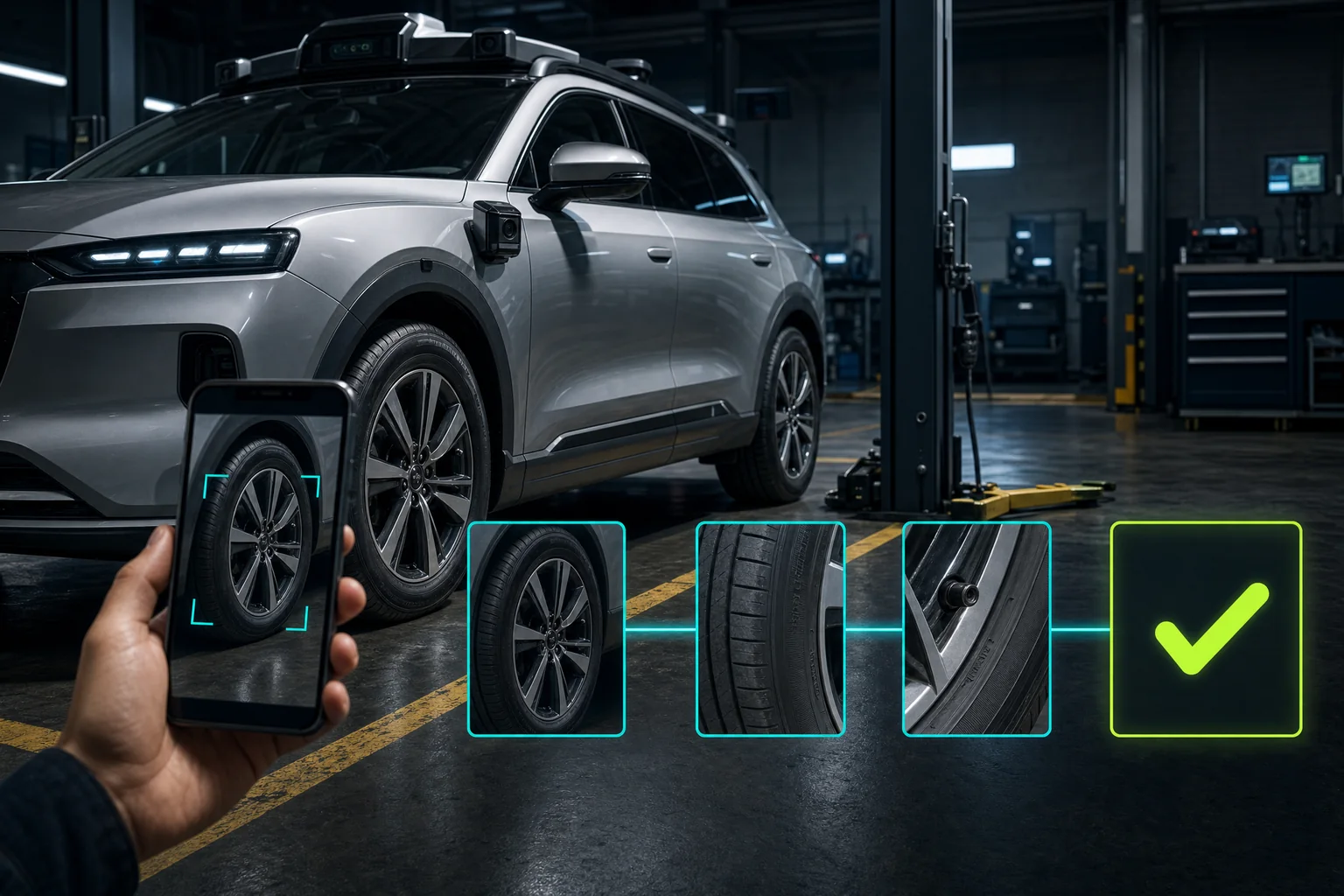
The unattended-service trust gap
No driver is waiting.The decision still needs evidence.
Matched identity, guided capture, exceptions, review result, and completion record stay connected.
Why ASV is necessary
Four questions stand between serviceand a trusted return.
Is this the right vehicle?
Plate, VIN, location, time, and relevant vehicle context can bind evidence to the correct service event.
Was the requested work addressed?
The evidence plan starts with the service order, required work, parts, and acceptance criteria.
What remains uncertain?
Missing, contradictory, or low-confidence evidence can trigger another capture or manual review instead of a silent approval.
What supports the next action?
A structured completion result can support vehicle release, service history, and downstream settlement where configured.
One continuous evidence chain
Capture once.Prove every step.
The guided flow keeps vehicle identity, requested scope, captured evidence, decision support, manual-review options, and the final record tied to one event.
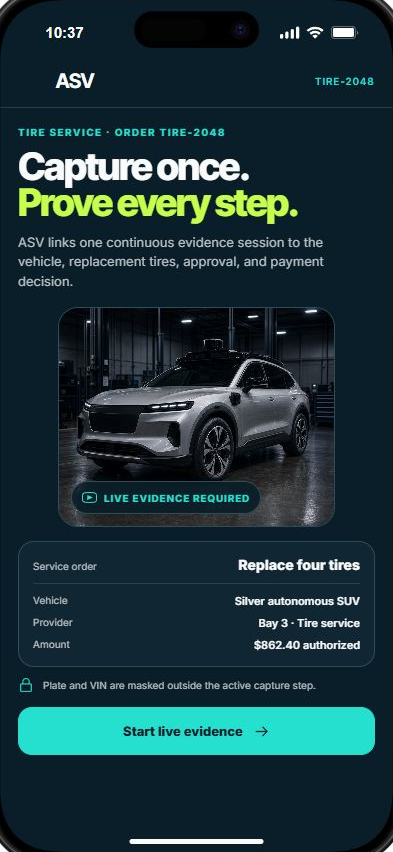 01 / Bind
Start from the exact order.
Vehicle, provider, bay, requested service, and authorized amount frame what must be proven.
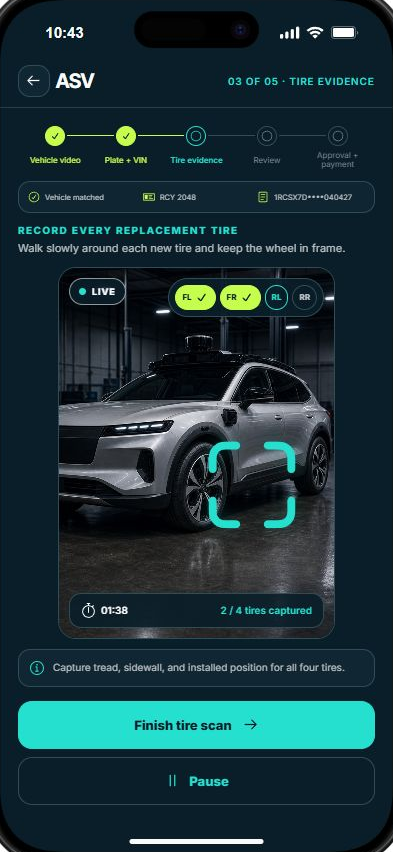 02 / Capture
Guide consistent evidence.
Continuous video, identity checks, and service-specific prompts reduce disconnected or incomplete submissions.
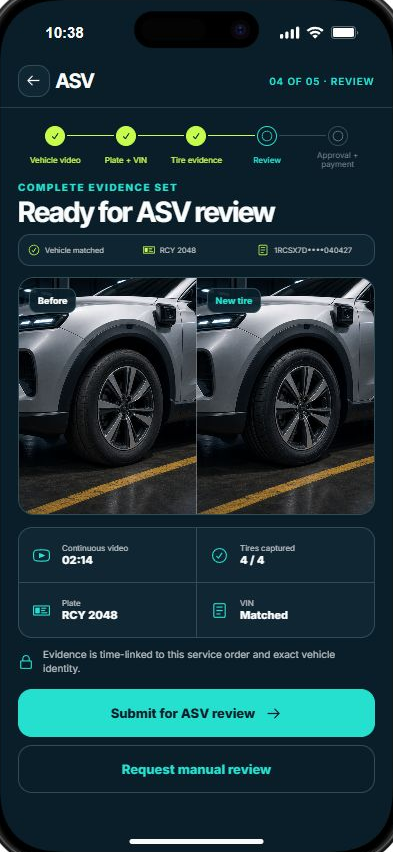 03 / Review
Compare scope and evidence.
AI-assisted review can surface confidence and exceptions, while additional evidence or manual review remains available.
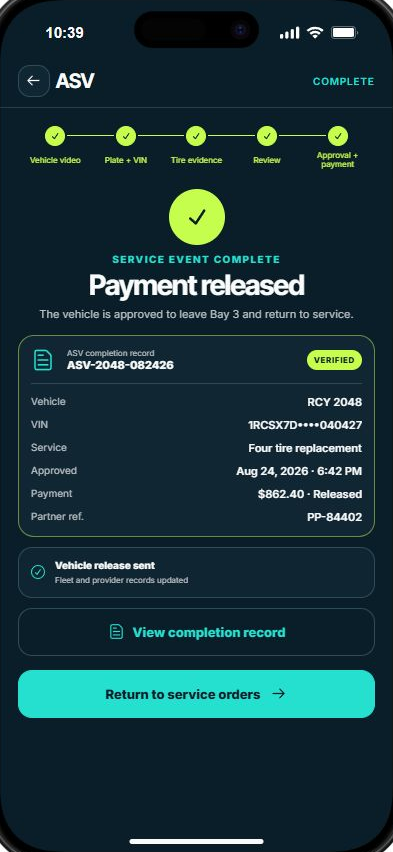 04 / Record
Preserve the decision.
A digital completion record can support release, service history, and payment workflow without separating proof from the transaction.
The screens show a conceptual ASV workflow and fictional vehicle, order, confidence, and payment data. Illustrative interfaces explain the intended workflow and do not imply commercial deployment at scale.
The ASV proof model
Evidence is structured aroundthe decision it must support.
ASV can combine multiple evidence types instead of treating a single photo or invoice as universal proof.
Clear boundary: ASV supports AI-assisted review; it does not promise that every service can or should be approved without additional evidence or human judgment.
- 01Service requirement
Order, requested work, required part, acceptance criteria.
- 02Matched identity
Vehicle, plate, VIN, event, location, time, and relevant state.
- 03Guided evidence
Photo, video, document, meter, diagnostic, or sensor evidence.
- 04Decision path
Approved, more evidence required, or manual review.
- 05Completion record
Result, exceptions, release support, and settlement handoff.
What ASV makes possible
Trust the service eventwithout inventing a digital witness.
- For fleetsReview a consistent evidence record before returning an unattended vehicle to operation.
- For providersKnow the required evidence and acceptance context before the vehicle leaves the bay.
- For operations teamsKeep approvals, exceptions, release, service history, and settlement support connected.